What is GEO?
GEO stands for Generative Engine Optimization, the optimization for generative AI systems such as ChatGPT, Perplexity, Google AI Overviews and Bing Copilot. Classic SEO aims at the blue links in Google search. GEO is about being named in the written-out answer these systems give. The difference matters: an AI answer usually names only two or three providers. If you are not one of them, you practically do not exist for that person, no matter how good your website is otherwise.
This is not a niche any more. ChatGPT now answers questions for around 900 million people a week, and Google’s AI Overviews reach over two billion users a month across more than 200 countries. Gartner even predicted that traditional search volume would drop by a quarter by 2026. It has not fallen that far, and the honest picture is that AI search is adding to Google rather than replacing it. But the shift is real and it is happening now. The open question is whether the machines mention you.
SEO and GEO, side by side
They overlap, but they are not the same job. The table shows where they differ.
| Classic SEO | GEO | |
|---|---|---|
| Goal | Rank in the list of links | Be named in the AI answer |
| Success looks like | Position 1 to 10 | Mentioned in the first sentences |
| Slots available | Ten blue links | Often just two or three names |
| What wins | Relevance, links, speed | Clear structure, quotable text, reputation |
| Time to effect | Weeks to months | Weeks, updates roll in continuously |
The good news: most of the groundwork pays into both. Clean schema, clear content and a solid reputation help your Google ranking and your odds of being quoted by an AI at the same time.
Why this matters for local businesses in particular
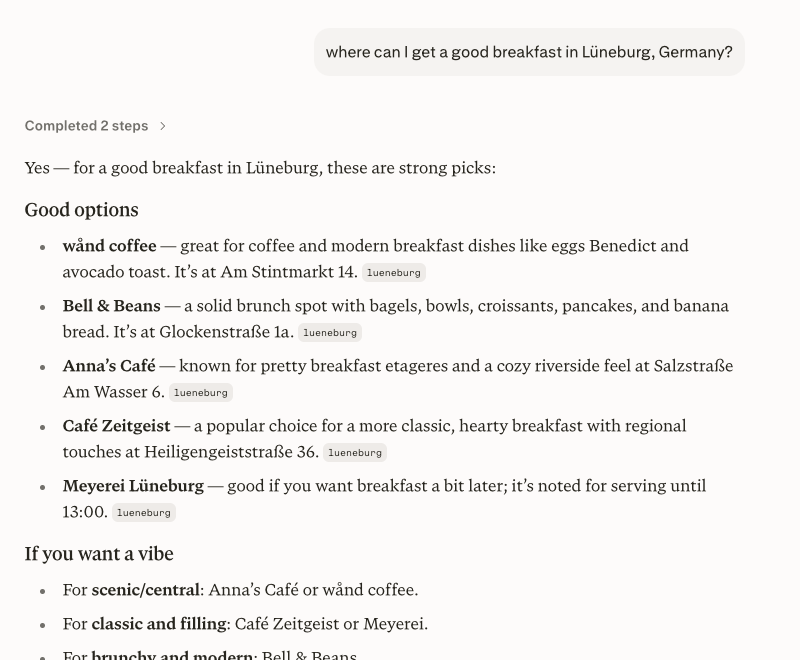
Questions like “which roofer in Lüneburg is worth recommending?” or “nice café in the old town for breakfast” are increasingly asked to AI systems instead of typed into Google. The answer relies on what the AI can find and understand about you on the web: your website, your Google Business Profile, your reviews and your mentions on local directories. If that foundation is thin, the AI falls back on the businesses it has clearer signals about, usually the competitor with more reviews and better-structured content. You lose the recommendation before the conversation even starts.
The four levers of AI visibility
Being recommended by an AI comes down to four things working together. A technically perfect site with no reviews gets skipped just as easily as a well-known business whose website gives the AI nothing usable.
- Accessibility. AI crawlers such as GPTBot and PerplexityBot need permission to read your site in robots.txt, and the page has to be understandable without heavy JavaScript. A Content-Signal line and a clean llms.txt make your intent explicit.
- Structure. One clear H1, sensible headings, and structured data (Schema.org) that states your services, location and opening hours without ambiguity. This is how the AI classifies you correctly instead of guessing.
- Content. Short, concrete passages that answer a real question directly get quoted far more often than vague marketing lines. A crisp “open Monday to Friday, 9 to 17” beats “flexible opening hours to suit you”.
- Reputation. Reviews and mentions on trustworthy sources are among the strongest signals. Ahrefs found in late 2025 that brand mentions correlate about three times more strongly with AI visibility than classic backlinks. What people say about you off your own site matters more than ever.
What an AI answer actually rewards
Take a real query: “who does SEO and AI visibility for local businesses in Lüneburg?” Ask Perplexity today and you get either a short list of named agencies or, on a quieter day, a generic “here is how to choose” answer with no names at all. Which one you get depends on the four levers above. The businesses that get named are the ones the AI can read, classify and trust, in that order. That is also why the field is still wide open for most local businesses: hardly anyone has done the groundwork yet.
How to get started, step by step
- Measure the status quo. Do you show up in AI answers for your most important terms at all, and if so, where? We check exactly this in our free short check, with real Perplexity queries, not guesses.
- Fix accessibility. Allow the AI crawlers, add a Content-Signal line to robots.txt, and put a clean llms.txt at your web root.
- Make content quotable. Add clear question-and-answer blocks, fill in your Schema.org data, and replace fluff with concrete facts and numbers.
- Build reputation. Collect honest reviews and get listed, correctly and consistently, on the directories that matter for your trade.
- Re-measure. AI systems update continuously but not instantly. Give it a few weeks, then check the same queries again.
GEO is not a trick and it is not a guarantee. AI answers vary from day to day, and no serious provider can promise you a fixed spot. What it is: solid groundwork that makes your business easy to find, understand and recommend, and that helps you in classic Google search at the same time.
Frequently asked questions
Is GEO the same as SEO?
No, but they overlap a lot. SEO aims at rankings in classic search, GEO at mentions in AI answers. Many measures (clean schema, clear content, good reputation) pay into both, which is why it rarely makes sense to do one without the other.
Can I stop AI systems from using my site?
Yes, individual AI crawlers can be excluded via robots.txt. But for visibility in AI answers you usually want to allow them explicitly, and to signal your intent with a Content-Signal line.
How fast does GEO work?
AI systems update their knowledge continuously, but not instantly. Expect weeks, not days. Reviews and mentions need some lead time anyway.
What if the AI names my competitor and not me?
That is the normal starting point, and it is fixable. It means the competitor currently gives the AI clearer signals. The four levers above are how you close that gap.